
Multi-Location Asset Verification in 2026: Why It’s Becoming a Serious Business Challenge
Managing assets in one office is already difficult. But when a company operates 50, 100, or even 1,000 stores across India, things become much more complicated.
From missing laptops and untagged machinery to duplicate records and audit delays, businesses are now facing serious operational risks. This is exactly why multi-location asset verification has become one of the biggest priorities for finance teams, internal auditors, and compliance managers in 2026.
Based on practical learnings from an ongoing 1,000-store RFID rollout project covering 250+ stores, companies are discovering that traditional barcode or Excel-based tracking systems are simply not enough anymore.
Businesses are now shifting toward RFID asset tracking systems to improve visibility, reduce losses, and automate physical asset verification.
For detailed RFID asset management insights, businesses can also explore TagMyAssets Official Website
Table of Contents
- What is Multi-Location Asset Verification?
- Why Traditional Asset Verification Fails
- 9 Real Challenges in Multi-Location Asset Verification
- How RFID Solves These Problems
- RFID Rollout Checklist for Enterprises
- Benefits of RFID Asset Verification
- Real Lessons From 250+ Stores
- FAQ – People Also Ask
- FAQ Schema Markup
What is Multi-Location Asset Verification?
Multi-location asset verification is the process of physically checking and validating company assets spread across multiple branches, warehouses, retail stores, factories, or offices.
These assets may include:
- Computers and laptops
- Furniture and fixtures
- Retail POS machines
- Manufacturing equipment
- IT hardware
- Warehouse inventory
- Vehicles and tools
The purpose is simple:
- Verify assets physically exist
- Match records with ERP or accounting books
- Detect missing or ghost assets
- Improve audit compliance
- Reduce asset leakage
In large enterprises, this process becomes extremely difficult without automation.
Why Traditional Asset Verification Fails in 2026
Most companies still rely on:
- Excel sheets
- Manual tagging
- Barcode scanning
- Paper registers
- Local staff reporting
But during large-scale verification, these methods create several issues:
| Traditional Method | Main Problem |
|---|---|
| Excel Tracking | Human errors |
| Barcode Scanning | Requires line-of-sight |
| Manual Audit | Slow and costly |
| Paper Registers | No real-time visibility |
| Local Reporting | High manipulation risk |
This is why RFID-based asset verification is growing rapidly in India.
9 Real Challenges in Multi-Location Asset Verification
1. Missing Assets Across Locations
One of the biggest problems companies face is assets disappearing during internal transfers.
For example:
- Laptop moved from Delhi to Pune
- No update in ERP
- Asset still appears in old location
Eventually auditors cannot find it.
This creates:
- Financial discrepancies
- Insurance complications
- Audit observations
RFID tracking helps maintain live movement visibility.
2. Duplicate Asset Records
In many enterprises, the same asset gets entered multiple times due to poor coordination between stores.
This usually happens because:
- Different branches maintain separate records
- No centralized asset database
- Manual data entry mistakes
Result?
Companies pay higher insurance premiums and show inflated asset values.
3. Non-Standard Asset Tagging
During large rollouts, every branch follows different tagging methods.
Examples:
- Different asset naming conventions
- Damaged barcode stickers
- Handwritten asset codes
- Untagged low-value assets
This creates massive confusion during audits.
RFID tags solve this problem because every asset gets a unique digital identity.
4. Staff Dependency During Verification
Traditional verification depends heavily on local store staff.
But practical issues happen:
- Staff unavailable
- Incomplete knowledge
- Wrong reporting
- Intentional hiding of missing assets
In many retail chains, verification delays happen only because branch employees are busy with operations.
RFID reduces dependency on manual support.
5. Verification Delays Across Multiple Cities
A company with 500+ branches may require months for physical verification.
Challenges include:
- Travel coordination
- Team scheduling
- Store accessibility
- Night shift verification
- Regional holidays
This increases operational cost heavily.
RFID readers can scan hundreds of assets within minutes.
6. Audit and Compliance Risks
Under Companies Act requirements and internal audit standards, businesses must maintain accurate asset records.
Poor verification can lead to:
- Qualification in audit reports
- Compliance penalties
- Internal control weakness
- Financial misstatements
Finance teams now prefer RFID-based asset audits because they improve documentation accuracy.
For compliance-related business advisory, companies often refer to Institute of Chartered Accountants of India (ICAI)
7. Difficulty Tracking Asset Movement
Assets continuously move between:
- Stores
- Warehouses
- Head offices
- Service centers
Without automated tracking, businesses lose visibility.
Example:
A printer transferred temporarily for repair may never return officially in records.
RFID gateways automatically capture movement data without manual entries.
8. Huge Verification Cost
Multi-location verification involves:
- Travel expense
- Hotel stays
- Temporary staff
- Audit manpower
- Operational downtime
For nationwide retail chains, this cost becomes very high.
RFID dramatically reduces repetitive verification effort.
9. No Real-Time Asset Visibility
Most companies discover asset issues only during annual audits.
That means:
- Missing assets stay unnoticed for months
- Ghost assets remain in books
- Dead stock continues depreciating
Real-time RFID dashboards provide instant visibility.
This helps management take faster decisions.
How RFID Solves Multi-Location Asset Verification Problems
RFID (Radio Frequency Identification) uses smart tags and scanners to track assets automatically.
Unlike barcodes:
- RFID does not need direct scanning
- Multiple assets scan together
- Faster verification process
- Better data accuracy
RFID Verification Process
Step 1 – RFID Tagging
Assets receive RFID labels.
Step 2 – Asset Mapping
Data mapped with ERP or asset register.
Step 3 – RFID Scanning
Handheld readers scan multiple assets instantly.
Step 4 – Real-Time Reporting
Dashboard updates automatically.
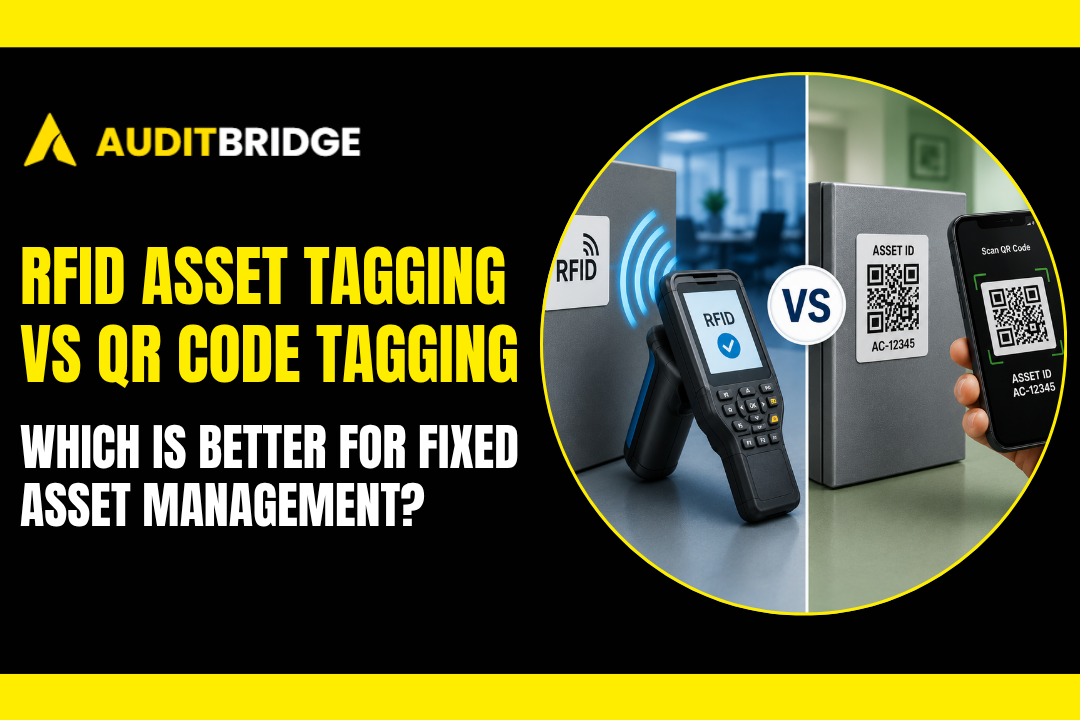
RFID vs Barcode Asset Verification
| Feature | Barcode | RFID |
|---|---|---|
| Scan Speed | Slow | Very Fast |
| Line of Sight Needed | Yes | No |
| Bulk Scanning | No | Yes |
| Accuracy | Medium | High |
| Automation | Limited | Advanced |
| Real-Time Visibility | No | Yes |
Real Lessons From 250+ Stores During RFID Rollout
During large-scale deployment projects, businesses learned some important practical lessons.
Key Learnings
Standardization is Critical
Every branch must follow same asset tagging rules.
Pilot Testing Saves Cost
Testing RFID in 5–10 stores before full rollout prevents future issues.
ERP Integration Matters
RFID without ERP integration creates duplicate work.
Staff Training Cannot Be Ignored
Employees must understand tagging and movement process properly.
Real-Time Dashboards Improve Accountability
Management gets faster visibility into asset movement and shortages.
RFID Rollout Checklist for Enterprises
Before Starting RFID Asset Verification
Technical Checklist
- Choose correct RFID tags
- Ensure ERP compatibility
- Test handheld scanners
- Configure centralized dashboard
Operational Checklist
- Create asset naming policy
- Define movement approval workflow
- Train branch employees
- Schedule pilot verification
Audit Checklist
- Verify asset master data
- Remove duplicate entries
- Map asset categories
- Document verification procedures
Benefits of RFID-Based Asset Verification
Operational Benefits
- Faster asset audits
- Reduced manual effort
- Better asset visibility
- Accurate reporting
Financial Benefits
- Reduced asset loss
- Lower audit cost
- Better depreciation tracking
- Improved insurance accuracy
Compliance Benefits
- Stronger audit documentation
- Better fixed asset controls
- Improved regulatory compliance
- Reduced financial discrepancies
What is the Future of Asset Verification in 2026?
The future is clearly moving toward:
- RFID automation
- AI-powered asset analytics
- Real-time dashboards
- Cloud-based verification systems
Large enterprises no longer want yearly manual audits only. They want continuous visibility.
That shift is changing how finance and operations teams manage fixed assets.
FAQ – People Also Ask
What is multi-location asset verification?
Multi-location asset verification is the process of physically checking company assets located across multiple branches, offices, or warehouses to ensure records match actual assets.
Why is RFID better than barcode for asset verification?
RFID allows bulk scanning without line-of-sight, making asset verification faster, more accurate, and less dependent on manual work compared to barcode systems.
How long does RFID asset verification take?
The duration depends on the number of assets and locations. However, RFID verification is usually 5–10 times faster than manual or barcode-based verification.
What industries use RFID asset tracking?
Industries using RFID include:
- Retail
- Manufacturing
- Healthcare
- Logistics
- IT companies
- Warehousing
- Education institutions
Can RFID integrate with ERP systems?
Yes. Modern RFID systems integrate with ERP, SAP, accounting software, and fixed asset management platforms for centralized visibility.