Many organizations invest heavily in asset management software expecting complete visibility over their fixed assets. However, despite having sophisticated systems, businesses still face missing assets, inaccurate records, audit observations, and compliance issues.
The primary reason is simple: Asset Management Software Fails Without Physical Verification and FAR Reconciliation.
Software can only manage the data available in the system. If the data itself is inaccurate, outdated, or incomplete, even the most advanced asset management solution cannot deliver reliable results.
As a practicing Chartered Accountant with over 10 years of experience in audits, fixed asset reviews, and compliance assessments, I have seen organizations lose lakhs of rupees because they relied solely on software while ignoring physical verification and Fixed Asset Register (FAR) reconciliation.
In this article, we will explain why physical verification and FAR reconciliation remain essential in 2026 and how organizations can build a truly effective asset management process.
Table of Contents
- What is Asset Management Software?
- What is Physical Asset Verification?
- What is FAR Reconciliation?
- Why Asset Management Software Fails Without Physical Verification and FAR Reconciliation
- Impact on Audits and Compliance
- Best Practices for Asset Management in 2026
- Physical Verification Checklist
- FAR Reconciliation Process
- Key Benefits of Integrated Asset Management
- FAQs
- FAQ Schema Markup
What is Asset Management Software?
Asset management software is a digital platform used to track, monitor, and manage organizational assets throughout their lifecycle.
It helps businesses record:
- Asset location
- Asset ownership
- Purchase details
- Depreciation records
- Maintenance schedules
- Asset transfers
- Disposal information
Examples include:
- Fixed asset management systems
- RFID asset tracking solutions
- Barcode asset tracking software
- Enterprise asset management (EAM) platforms
While these systems improve efficiency, they depend entirely on accurate asset data.
What is Physical Asset Verification?
Physical asset verification is the process of physically inspecting and validating the existence, condition, location, and identification of assets recorded in company records.
In Simple Words
Physical verification answers one question:
“Does the asset actually exist where the records say it exists?”
During verification, teams check:
- Asset tag
- Barcode
- RFID label
- Serial number
- Location
- User department
- Asset condition
Without verification, software records become assumptions rather than facts.
What is FAR Reconciliation?
FAR reconciliation refers to matching the physical assets found during verification with the organization’s Fixed Asset Register (FAR).
The process identifies:
| Reconciliation Issue | Description |
|---|---|
| Missing Assets | Assets in FAR but not physically available |
| Unrecorded Assets | Assets found physically but missing in FAR |
| Duplicate Assets | Same asset recorded multiple times |
| Wrong Locations | Assets moved without updates |
| Incorrect Asset Values | Mismatch between records and actual asset data |
FAR reconciliation ensures accounting records match ground reality.
7 Critical Reasons Why Asset Management Software Fails Without Physical Verification and FAR Reconciliation
1. Garbage In, Garbage Out
Software accuracy depends on data accuracy.
If incorrect information is entered into the system, the software will continue producing incorrect reports.
Common examples:
- Wrong asset location
- Incorrect serial number
- Duplicate entries
- Missing asset tags
Without physical verification, these errors remain hidden.
2. Missing Assets Go Undetected
Organizations frequently discover:
- Laptops missing
- Servers relocated
- Machinery disposed without records
- Furniture transferred between branches
Software cannot identify missing assets automatically unless someone physically verifies them.
This is one of the biggest reasons asset management software implementations fail.
3. FAR Becomes Outdated Over Time
Assets continuously move across departments and locations.
Examples:
- Employee transfers
- Branch relocations
- Equipment replacements
- Asset disposals
If these changes are not updated immediately, the Fixed Asset Register gradually loses reliability.
Regular FAR reconciliation restores data accuracy.
4. Audit Qualifications and Compliance Risks Increase
During statutory audits, internal audits, and tax assessments, auditors often review:
- Fixed Asset Register
- Asset verification reports
- Asset tagging records
- Disposal documentation
When discrepancies exist between physical assets and FAR records, organizations may face:
- Audit observations
- Internal control weaknesses
- Regulatory concerns
- Financial reporting issues
5. Depreciation Calculations Become Incorrect
Depreciation is calculated based on assets recorded in books.
If assets:
- No longer exist,
- Have been disposed,
- Are duplicated,
then depreciation expenses become inaccurate.
This directly affects:
- Profitability
- Tax calculations
- Financial statements
FAR reconciliation helps maintain accurate depreciation records.
6. Asset Tracking Technologies Alone Are Not Enough
Many organizations deploy:
- RFID asset tracking
- Barcode asset tracking
- QR code asset management
While these technologies improve visibility, they still require periodic physical validation.
Reasons include:
- Damaged tags
- Missing labels
- Incorrect tagging
- Human errors
Technology supports verification but cannot replace it.
7. Strategic Decision-Making Suffers
Management decisions depend on accurate asset data.
Examples include:
- Budget planning
- Asset replacement
- Capital expenditure
- Insurance valuation
If asset records are inaccurate, management decisions become risky.
Reliable physical verification and FAR reconciliation create trustworthy data for decision-makers.
Impact on Audits and Compliance
Internal Audit
Internal auditors assess whether asset controls are functioning effectively.
Key verification areas include:
- Asset existence
- Asset ownership
- Asset movement controls
- Asset disposal approvals
Statutory Audit
External auditors often request:
- Fixed Asset Register
- Verification reports
- FAR reconciliation reports
Inaccurate records can result in audit remarks.
Companies Act Compliance
Maintaining accurate books and asset records is a key governance requirement under applicable corporate regulations.
Regular verification supports stronger compliance practices.
Best Practices for Asset Management in 2026
Combine Technology with Verification
The most successful organizations integrate:
- Asset Management Software
- Physical Asset Verification
- FAR Reconciliation
- Asset Tagging
- Continuous Monitoring
Use Barcode or RFID Tagging
Benefits include:
- Faster audits
- Better asset tracking
- Reduced human errors
- Improved accountability
Conduct Annual Verification
Recommended frequency:
| Asset Type | Verification Frequency |
|---|---|
| IT Assets | Every 6-12 Months |
| Furniture | Annually |
| Plant & Machinery | Annually |
| High-Value Assets | Quarterly |
Maintain Real-Time FAR Updates
Every asset movement should be recorded immediately.
Include:
- Transfer date
- User details
- Department
- Location
Physical Asset Verification Checklist
Use this checklist during verification:
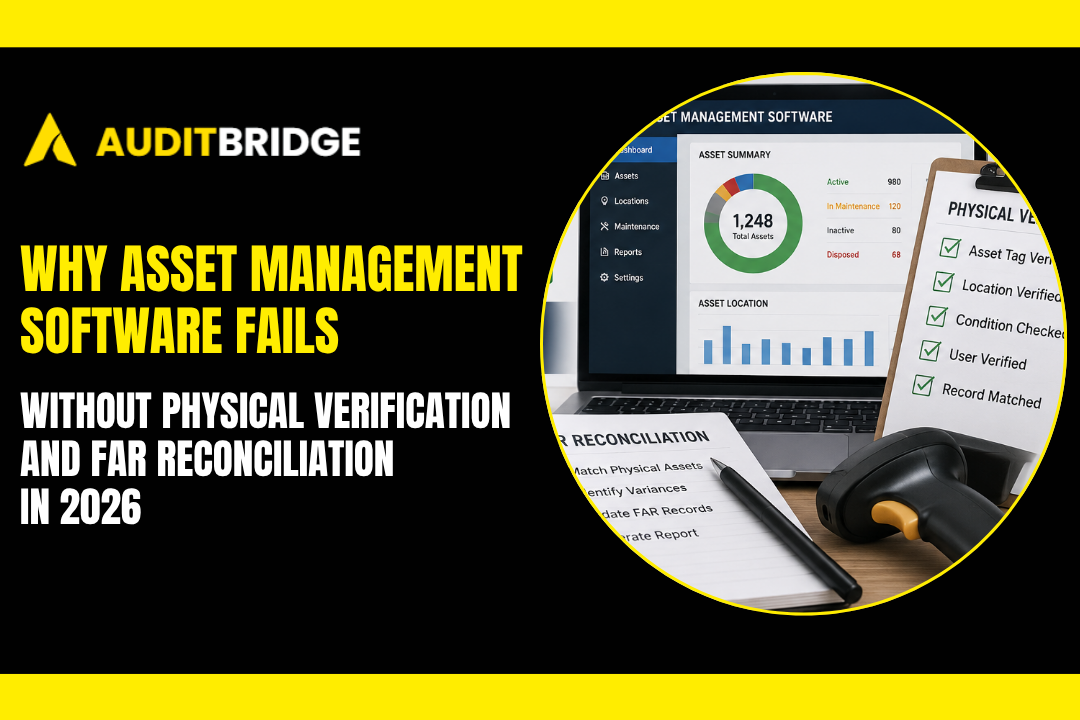
Asset Verification Checklist
✔ Asset physically available
✔ Asset tag visible
✔ Serial number matched
✔ Correct location verified
✔ User department confirmed
✔ Asset condition checked
✔ FAR entry verified
✔ Photograph captured
✔ Disposal status checked
✔ Reconciliation completed
FAR Reconciliation Process
Step 1: Extract FAR Data
Download latest FAR records.
Step 2: Conduct Physical Verification
Verify all assets physically.
Step 3: Identify Variances
Find:
- Missing assets
- Unrecorded assets
- Location mismatches
Step 4: Investigate Exceptions
Review supporting documents.
Step 5: Update FAR
Correct records after approval.
Step 6: Generate Reconciliation Report
Prepare management and audit reports.
Conclusion
The biggest misconception in asset management is believing that software alone can solve asset tracking challenges.
In reality, Asset Management Software Fails Without Physical Verification and FAR Reconciliation because software only manages the information available within the system.
Organizations that combine technology, physical verification, and FAR reconciliation achieve:
- Better asset visibility
- Stronger compliance
- Accurate financial reporting
- Improved audit readiness
- Higher operational efficiency
In 2026, successful asset management is no longer about having software alone. It is about ensuring that software reflects actual ground reality.
FAQs (People Also Ask)
Why does asset management software fail?
Asset management software fails when asset data is inaccurate, outdated, or incomplete. Without physical verification and FAR reconciliation, the software cannot provide reliable asset information.
Answer (Featured Snippet Ready)
Asset management software fails because it depends on accurate asset records. If assets are missing, duplicated, relocated, or incorrectly recorded, software reports become unreliable. Physical verification and FAR reconciliation ensure the system reflects actual asset conditions and locations.
What is FAR reconciliation?
FAR reconciliation is the process of matching physical assets with the Fixed Asset Register to identify missing assets, duplicate entries, location mismatches, and record inaccuracies.
How often should physical asset verification be conducted?
Most organizations should conduct physical asset verification annually. High-value assets and IT equipment may require quarterly or semi-annual verification depending on risk levels.
Why is physical verification important in audits?
Physical verification provides evidence that recorded assets actually exist. Auditors use verification reports to validate fixed asset records and assess internal controls.
Can RFID replace physical asset verification?
No. RFID improves asset tracking but cannot completely replace physical verification. Periodic inspections are still necessary to validate asset existence, condition, and tagging accuracy.