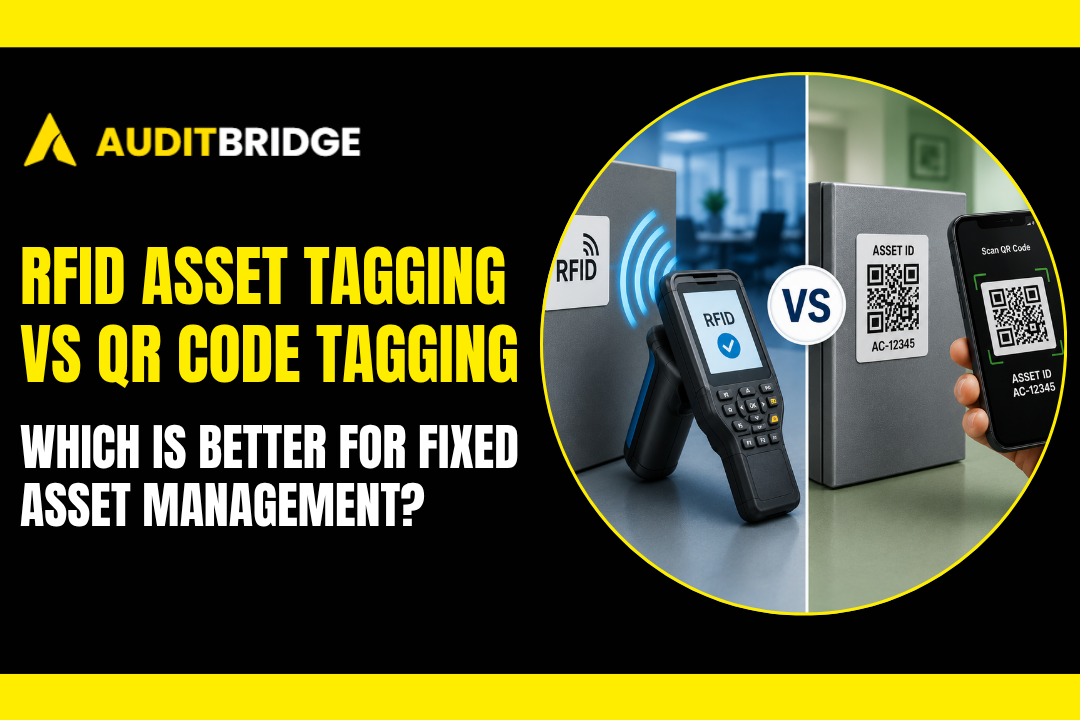
RFID Asset Tagging vs QR Code Tagging is one of the most common discussions among finance teams, auditors, facility managers, and asset management professionals in 2026.
Companies spend crores on laptops, servers, machinery, office furniture, IT equipment, and plant assets. However, many organizations still struggle to answer a simple question:
Can they physically locate and verify every asset recorded in their Fixed Asset Register (FAR)?
The answer depends largely on the asset tagging system being used.
Two of the most popular methods are RFID asset tagging and QR code asset tagging. Both help organizations improve asset tracking, physical verification, inventory audits, and FAR reconciliation. However, each technology has unique advantages and limitations.
In this guide, we’ll compare RFID and QR code tagging in detail and help you choose the right solution for your business.
Table of Contents
- What is RFID Asset Tagging?
- What is QR Code Asset Tagging?
- RFID Asset Tagging vs QR Code Tagging
- Key Differences Explained
- Cost Comparison
- Best Use Cases
- Which One Should You Choose?
- Implementation Checklist
- FAQs
- FAQ Schema Markup
What is RFID Asset Tagging?
RFID Asset Tagging uses Radio Frequency Identification technology to track assets through radio waves.
An RFID tag contains a microchip and antenna. RFID readers can detect and capture asset information without direct line-of-sight scanning.
Example
An employee walks through a room with an RFID scanner, and hundreds of tagged assets are identified automatically within seconds.
Benefits of RFID Asset Tagging
- Fast asset counting
- Bulk scanning capability
- Reduced manual effort
- Better inventory accuracy
- Real-time asset visibility
- Suitable for large enterprises
What is QR Code Asset Tagging?
QR Code Asset Tagging uses printed QR codes attached to assets.
Each QR code contains a unique asset identification number linked to an asset management system.
To verify an asset, users scan the QR code using a mobile phone or handheld scanner.
Example
An auditor scans a laptop’s QR code and instantly accesses purchase date, location, custodian details, and asset history.
Benefits of QR Code Tagging
- Low implementation cost
- Easy deployment
- Smartphone compatibility
- Minimal training required
- Ideal for SMEs and startups
RFID Asset Tagging vs QR Code Tagging: Quick Comparison Table
| Feature | RFID Tagging | QR Code Tagging |
|---|---|---|
| Scanning Method | Radio Frequency | Optical Scan |
| Line of Sight Required | No | Yes |
| Bulk Asset Scanning | Yes | No |
| Initial Cost | Higher | Lower |
| Speed | Very Fast | Moderate |
| Asset Verification Accuracy | High | High |
| Infrastructure Requirement | RFID Readers | Smartphone Scanner |
| Maintenance Cost | Medium | Low |
| Suitable for Large Asset Base | Excellent | Good |
| Audit Efficiency | Excellent | Very Good |
7 Powerful Differences Between RFID and QR Code Tagging
1. Asset Scanning Speed
RFID technology can scan multiple assets simultaneously.
A warehouse containing thousands of assets can be verified within minutes.
QR code tagging requires scanning each asset individually, making the process slower.
Winner: RFID
2. Line-of-Sight Requirement
RFID readers can detect tags even when assets are inside cabinets, racks, or storage rooms.
QR codes must be visible to the scanner.
Winner: RFID
3. Implementation Cost
Cost remains one of the biggest deciding factors.
RFID Costs Include
- RFID tags
- RFID readers
- Software integration
- Staff training
QR Code Costs Include
- QR labels
- Asset management software
- Mobile application
For most organizations, QR implementation costs significantly less.
Winner: QR Code
4. Ease of Deployment
QR code tagging can be deployed quickly.
Most organizations already have smartphones that can scan QR codes.
RFID implementation often requires specialized hardware and infrastructure.
Winner: QR Code
5. Asset Verification During Audits
Annual fixed asset verification becomes easier with both technologies.
However, RFID reduces manual effort dramatically.
Auditors can verify large asset populations without individually scanning every asset.
Winner: RFID
6. Accuracy of Asset Tracking
Both systems improve asset tracking accuracy when compared to manual records.
However, RFID offers greater automation and fewer human errors.
Winner: RFID
7. Scalability
As businesses grow, asset counts increase rapidly.
Organizations managing:
- Multiple branches
- Warehouses
- Manufacturing plants
- Large campuses
often benefit more from RFID technology.
Winner: RFID
RFID vs QR Code Tagging: Cost Comparison
| Business Size | Recommended Technology |
|---|---|
| Startup | QR Code |
| Small Business | QR Code |
| Medium Enterprise | QR Code or RFID |
| Large Enterprise | RFID |
| Manufacturing Plant | RFID |
| Multi-location Company | RFID |
| Educational Institutions | QR Code |
| Managed Offices | QR Code |
A company with 500 assets may not justify RFID investment.
A company managing 50,000 assets across multiple locations often sees strong ROI from RFID deployment.
Best Use Cases for RFID Asset Tagging
RFID is suitable when:
✔ Asset count exceeds 5,000
✔ Multiple locations exist
✔ Frequent audits are required
✔ Assets move regularly
✔ Real-time tracking is needed
✔ Large warehouses are involved
Best Use Cases for QR Code Tagging
QR Code tagging is ideal when:
✔ Budget is limited
✔ Asset count is under 5,000
✔ Annual verification is sufficient
✔ Smartphones are used by staff
✔ Quick deployment is required
✔ Compliance tracking is the main objective
Which Technology Is Better for Fixed Asset Management in 2026?
There is no one-size-fits-all answer.
Choose RFID If:
- You manage thousands of assets.
- Audit speed is critical.
- Real-time asset visibility is needed.
- Asset movement is frequent.
Choose QR Code If:
- Cost efficiency is important.
- Asset count is manageable.
- Annual physical verification is sufficient.
- Easy implementation is preferred.
For many organizations, QR code asset tagging provides the best balance of affordability, compliance, and operational efficiency.
Large enterprises often combine RFID and QR technologies for maximum control.
Fixed Asset Verification Checklist
Use this checklist before selecting an asset tagging solution:
Technology Evaluation Checklist
- Asset count identified
- FAR available
- Physical verification frequency defined
- Audit requirements assessed
- Budget approved
- Software compatibility checked
- Future scalability considered
- Asset movement analyzed
- Compliance needs evaluated
- Asset tagging vendor finalized
People Also Ask (FAQs)
What is RFID Asset Tagging?
RFID Asset Tagging is a method of tracking assets using radio frequency technology. RFID tags communicate with readers through radio waves, allowing assets to be identified without direct scanning.
What is QR Code Asset Tagging?
QR Code Asset Tagging uses unique QR labels attached to assets. Users scan the code with a smartphone or scanner to access asset information and update records.
Is RFID better than QR code tagging?
RFID is generally better for large enterprises because it supports bulk scanning and faster audits. QR codes are better for organizations looking for a cost-effective asset tracking solution.
Which asset tagging method is cheaper?
QR code tagging is significantly cheaper because it requires only printed labels and mobile devices, while RFID requires specialized readers and RFID tags.
Can RFID replace QR codes?
Not completely. Many organizations use both technologies together. RFID improves automation, while QR codes provide a simple and affordable backup identification method.
Does RFID improve fixed asset audits?
Yes. RFID can reduce audit time significantly by allowing multiple assets to be scanned simultaneously, improving efficiency and reducing manual effort.
Conclusion
The RFID Asset Tagging vs QR Code Tagging debate is not about which technology is universally better. It is about choosing the right solution based on asset volume, budget, compliance requirements, and operational complexity.
For most small and medium-sized businesses, QR code asset tagging offers excellent value and strong control over fixed assets.
For enterprises handling thousands of assets across multiple locations, RFID delivers superior speed, automation, and scalability.
The best fixed asset management strategy in 2026 is one that combines technology, physical verification, and Fixed Asset Register reconciliation to ensure every asset recorded actually exists and can be verified during audits.
Internal Link Suggestions
- Fixed Asset Verification Services
- FAR Reconciliation Services
- Asset Tagging Solutions
- Asset Management Software
- Fixed Asset Register Management
External Resources (DoFollow)
- Institute of Chartered Accountants of India (ICAI)
- Ministry of Corporate Affairs (MCA)
- ISO 55000 Asset Management Standards